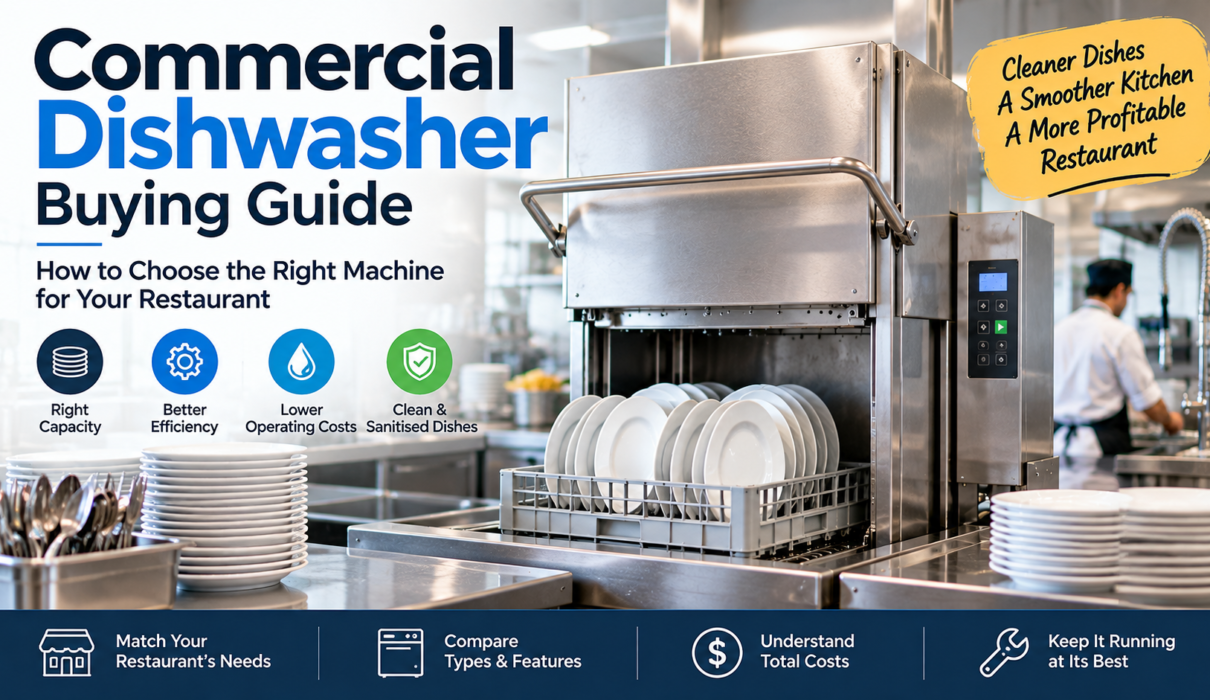
Commercial Dishwasher Buying Guide: How to Choose the Right Machine for Your Restaurant
Choosing a commercial dishwasher is not simply about finding a machine that washes dishes quickly. The right model needs to match the restaurant’s dish volume, available space, kitchen workflow, utilities, wash requirements, and operating costs. A small café and a high-volume restaurant can have completely different dishwasher requirements.
The main commercial dishwasher types include undercounter, door-type, conveyor, flight-type, and glasswashers. Capacity, cycle time, rack size, water consumption, sanitisation method, installation requirements, and maintenance access should all be evaluated before purchasing.
Table of Contents
What Is a Commercial Dishwasher and How Does It Work?
A commercial dishwasher is designed to clean and sanitise large quantities of plates, glasses, utensils, cookware, and other food-service items through controlled wash and rinse cycles.
Unlike a residential dishwasher, commercial equipment is built for higher throughput and repeated operating cycles. Most machines use a combination of heated water, detergent, mechanical spray pressure, and a final rinse to remove food residue and sanitise the ware.
A typical cycle follows these stages:
- Pre-rinse or scraping: Food debris is removed before items enter the machine.
- Wash cycle: Detergent and heated water are sprayed through wash arms or nozzles.
- Rinse cycle: Cleaner water removes detergent and remaining residue.
- Final rinse: A high-temperature rinse or chemical sanitisation process is used, depending on the machine and local requirements.
- Draining: Used water is removed before the next cycle.
The machine’s actual operating temperatures, sanitisation method, cycle duration, and chemical requirements vary by model. Restaurants should follow the manufacturer’s specifications and applicable local food-safety requirements rather than relying on a generic temperature figure.
What Types of Commercial Dishwashers Are Available?
The dishwasher type should match the restaurant’s volume and kitchen layout. Buying a machine with more capacity than the operation needs can increase upfront and operating costs, while an undersized machine can create dishwashing bottlenecks.
Undercounter Dishwashers
An undercounter dishwasher fits beneath a commercial worktop and is generally suited to smaller restaurants, cafés, bars, and food-service operations with moderate dish volumes.
Its main advantage is its compact footprint. Staff can load racks directly from a nearby preparation or washing station without moving dishes across a large dishroom.
An undercounter machine can be appropriate when:
- Kitchen space is limited.
- Dish volume is moderate.
- A dedicated dishwashing station is not available.
- Glassware and plates need relatively quick turnaround.
Its capacity is lower than that of larger pass-through or conveyor systems, so it may not be appropriate for high-volume operations.
Door-Type or Pass-Through Dishwashers
A door-type dishwasher is installed between loading and unloading areas. The operator places a rack inside, closes the hood or door, and starts the cycle.
This arrangement can improve workflow because dirty ware enters from one side and clean ware can be removed from the opposite side.
Door-type machines are commonly considered for:
- Full-service restaurants
- Hotels
- Institutional kitchens
- Medium-volume food-service operations
They provide greater rack capacity than most undercounter models while requiring less space than a conveyor system.
Conveyor Dishwashers
Conveyor dishwashers are designed for high-volume operations. Racks or ware move continuously through different washing and rinsing stages.
They are commonly considered by:
- Large restaurants
- Hotels
- Hospitals
- Universities
- Large cafeterias
- High-volume catering operations
A conveyor system requires more floor space and typically involves more installation planning. The kitchen layout needs to accommodate loading, unloading, water connections, drainage, ventilation where required, and staff movement.
Flight-Type Dishwashers
Flight-type systems are intended for very high-volume food-service environments. Instead of relying on standard racks moving through the machine, ware is transported continuously through the washing system.
These systems are generally associated with large institutional and high-volume commercial kitchens, where dish throughput is substantial enough to justify a larger installation.
Glasswashers
Glasswashers are designed specifically for bars, cafés, pubs, and operations where large quantities of glasses need to be cleaned.
A dedicated glasswasher can help separate glassware cleaning from the main dishwashing process and may use racks and wash programmes designed for glassware.
How Do You Choose the Right Commercial Dishwasher for Your Restaurant?
The correct dishwasher should be selected based on peak demand, not just the average number of dishes washed each day.
Start by estimating how many racks, plates, glasses, utensils, and other items need to be processed during the busiest service period.
1. Calculate Peak Dish Volume
Suppose a restaurant handles significantly more dishes during dinner than lunch. Selecting a dishwasher based only on the daily average could leave the kitchen short of capacity during the busiest period.
Consider:
- Number of meals served during peak periods
- Number of plates used per customer
- Glassware volume
- Cutlery volume
- Pots and pans requiring washing
- Number of available racks
- Expected cycle frequency
The goal is to determine the required throughput per hour, rather than simply choosing the machine with the largest advertised capacity.
2. Measure Available Space
Before selecting a dishwasher, measure the available installation area.
Check:
- Machine width
- Depth
- Height
- Door or hood clearance
- Loading and unloading space
- Service access
- Drain location
- Water connection location
- Electrical or gas requirements
A dishwasher that physically fits the opening may still be unsuitable if staff cannot comfortably load racks or technicians cannot access service components.
3. Match the Machine to Kitchen Workflow
The dishwasher should sit logically within the dirty-to-clean workflow.
A practical layout is:
Dirty dish collection → scraping/pre-rinse → dishwasher → clean dish unloading → storage
If staff must repeatedly cross the kitchen with dirty or clean racks, the dishwasher can become a workflow bottleneck even when its rated capacity is sufficient.
4. Consider the Restaurant Type
Different operations produce different types of dishwashing demand.
| Restaurant type | Potential dishwasher choice |
|---|---|
| Small café | Undercounter |
| Bar | Glasswasher |
| Medium restaurant | Door-type |
| Busy full-service restaurant | Door-type or conveyor |
| Hotel kitchen | Conveyor or flight-type |
| Large institutional kitchen | Conveyor or flight-type |
These are starting points rather than fixed rules. Actual selection should be based on volume, layout, ware mix, and manufacturer specifications.
What Features Should You Look for in a Commercial Dishwasher?
Capacity is only one part of the purchasing decision. Several technical features can affect cleaning performance and operating costs.
Wash Cycle Time
Shorter cycles can increase throughput, but cycle time should not be evaluated separately from cleaning performance.
A machine that completes cycles quickly but requires repeated washing because of poor loading, inadequate scraping, or unsuitable wash settings may not provide the expected productivity.
Water Consumption
Water usage affects operating costs, particularly in restaurants running hundreds of cycles or racks per week.
Compare the manufacturer’s stated water consumption under a defined operating condition rather than comparing isolated numbers from different machines.
Also consider whether the machine includes features such as:
- Efficient rinse systems
- Water-level controls
- Filtration
- Soil management
- Energy-saving modes
Temperature and Sanitisation
Commercial dishwashers may use high-temperature sanitisation or chemical sanitisation, depending on the machine design.
The correct approach is to verify:
- Required wash temperature
- Final rinse temperature where applicable
- Chemical concentration requirements
- Sanitisation method
- Applicable local health-code requirements
Do not assume that every commercial dishwasher operates at the same temperature.
Filtration System
Filters capture food particles and prevent debris from continuously circulating through the wash system.
A machine with accessible filtration components can make routine cleaning easier and help maintain wash performance.
Automatic Detergent and Rinse-Aid Dispensing
Automatic chemical dispensing can help maintain consistent detergent and rinse-aid dosing when correctly installed and maintained.
The system still needs:
- Correct chemical selection
- Proper concentration
- Regular chemical supply
- Periodic inspection
- Calibration or servicing when required
Diagnostic Controls
Digital displays and diagnostic systems can make troubleshooting easier by showing operating conditions or fault information.
Depending on the model, controls may provide information about:
- Temperature
- Cycle status
- Error codes
- Water levels
- Maintenance requirements
These features can reduce the time needed to identify common operating problems.
How Much Does a Commercial Dishwasher Cost?
There is no single commercial dishwasher price that applies to every restaurant. Cost depends heavily on the dishwasher type, capacity, automation, construction, features, and installation requirements.
The purchase price is only one part of the total cost.
A restaurant should also account for:
- Installation
- Plumbing
- Electrical work
- Ventilation requirements
- Water treatment
- Detergent and rinse aid
- Energy consumption
- Water consumption
- Preventive maintenance
- Replacement parts
- Repairs
- Staff time
For example, a low-cost dishwasher may appear attractive initially but become more expensive to operate if it consumes significantly more water, requires frequent repairs, or cannot handle peak demand.
Conversely, a higher-capacity machine may not make financial sense for a small operation that rarely approaches its capacity.
Purchase Cost vs. Total Operating Cost
A useful purchasing comparison is:
Total cost of ownership = purchase + installation + utilities + chemicals + maintenance + repairs
This gives restaurant operators a more realistic basis for comparing machines than purchase price alone.
How Can You Maintain a Commercial Dishwasher?
Regular maintenance protects cleaning performance and reduces avoidable breakdowns.
Daily Maintenance
At the end of the operating day:
- Remove food debris.
- Clean the filters.
- Drain the machine according to the manufacturer’s procedure.
- Clean wash and rinse areas.
- Inspect spray arms or nozzles for blockage.
- Wipe door seals and accessible surfaces.
- Check detergent and rinse-aid supplies.
Weekly Maintenance
Depending on the manufacturer’s instructions:
- Inspect spray arms.
- Check nozzles for mineral buildup.
- Inspect door gaskets.
- Clean internal surfaces.
- Check drain components.
- Look for leaks.
- Examine chemical lines.
Periodic Maintenance
A qualified technician should inspect components according to the manufacturer’s maintenance schedule.
This may include checking:
- Heating components
- Pumps
- Valves
- Thermostats and temperature sensors
- Chemical dispensing systems
- Door mechanisms
- Electrical connections
- Water inlet components
Hard-water environments may also require more frequent descaling. Mineral deposits can restrict spray nozzles, reduce heating efficiency, and affect overall machine performance.
What Should You Check Before Buying a Commercial Dishwasher?
Before placing an order, verify these points against the manufacturer’s specifications:
- Capacity: Can the machine handle peak dish volume?
- Dimensions: Will it fit the available space with sufficient service clearance?
- Utilities: Does the facility have the required water, drainage, electrical or gas connections?
- Sanitisation: Does the machine’s sanitisation method meet the restaurant’s applicable requirements?
- Cycle time: Can it provide sufficient throughput during peak service?
- Water consumption: How much water does it use under comparable operating conditions?
- Chemical requirements: What detergent and rinse-aid systems are required?
- Maintenance: Can staff easily access filters, spray arms and other routine-cleaning components?
- Service: Are replacement parts and qualified technicians available?
- Total cost: What will the machine cost to purchase, install and operate over its expected service life?
Final Takeaway: Choosing the Right Commercial Dishwasher For Your Space
The right commercial dishwasher is the one that matches the restaurant’s peak dishwashing demand, available kitchen space, ware type, workflow, utilities, sanitisation requirements, and operating budget. Undercounter machines can suit smaller operations, door-type models provide greater capacity for medium-volume kitchens, while conveyor and flight-type systems are designed for substantially higher throughput. Before purchasing, compare cycle capacity, water and energy consumption, installation requirements, maintenance access, service support, and total operating cost rather than choosing a machine based only on purchase price.
FAQs
What is the best type of commercial dishwasher for a restaurant?
The best commercial dishwasher depends on the restaurant’s dish volume, available space, kitchen layout, and workflow. Undercounter machines can suit smaller operations, while door-type, conveyor, and flight-type machines are designed for progressively higher-volume applications.
How do I choose the right size commercial dishwasher?
Choose a dishwasher based on peak dishwashing demand rather than average daily volume. Consider the number of meals served during busy periods, plates and glasses used per customer, rack capacity, cycle time, and the amount of cookware that also needs washing.
What are the main types of commercial dishwashers?
The main types are undercounter, door-type or pass-through, conveyor, flight-type, and glasswashers. Each type has different capacity, space, workflow, and installation requirements.
How much does a commercial dishwasher cost?
Commercial dishwasher costs vary according to machine type, capacity, automation, features, installation requirements, and manufacturer. Restaurants should also consider water, energy, chemicals, maintenance, repairs, and other operating costs when comparing machines.
What is the difference between an undercounter and conveyor dishwasher?
An undercounter dishwasher is compact and generally suited to smaller or moderate-volume operations. A conveyor dishwasher is designed for higher throughput and uses a continuous rack-handling system, making it more appropriate for large restaurants, hotels, cafeterias, and institutional kitchens.
How often should a commercial dishwasher be cleaned?
Commercial dishwashers should generally receive routine cleaning at the end of each operating day, including removal of food debris and cleaning of filters and accessible components. Spray arms, nozzles, seals, drains, and other components should be inspected and cleaned according to the manufacturer’s maintenance instructions.
Do commercial dishwashers use high temperatures?
Some commercial dishwashers use high-temperature sanitisation, while others use chemical sanitisation. The operating temperature and sanitisation process depend on the machine’s design and manufacturer specifications. Restaurants should follow applicable food-safety requirements for their location.
Are commercial dishwashers water efficient?
Modern commercial dishwashers can incorporate water-saving features, but water consumption varies considerably between models and operating conditions. Compare manufacturer specifications using consistent measurements before purchasing.
What should be considered before installing a commercial dishwasher?
Check the machine’s dimensions, service clearance, water supply, drainage, electrical or gas requirements, ventilation requirements where applicable, chemical connections, and loading and unloading space before installation.
How can I reduce commercial dishwasher operating costs?
Operating costs can be reduced by selecting an appropriately sized machine, avoiding unnecessary cycles, maintaining filters and spray arms, preventing mineral buildup, using the correct detergent and rinse aid, and following the manufacturer’s maintenance procedures.