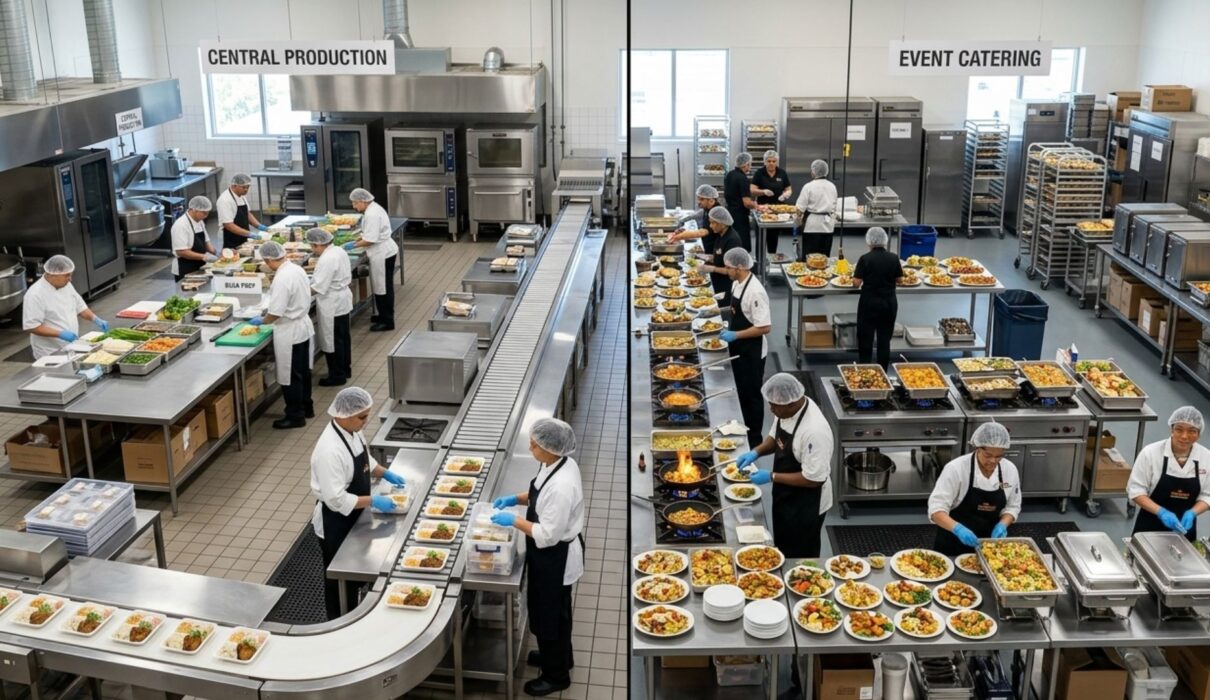
Central Kitchen vs Catering Equipment: A Strategic Infrastructure Guide for Restaurant Chains
Expansion in the restaurant industry requires more than brand visibility and outlet growth. It requires operational architecture that supports consistency, cost control, and revenue scalability. Among the most significant infrastructure decisions facing restaurant chains is whether to invest in a central kitchen, deploy professional catering equipment, or build a coordinated hybrid model.
This decision shapes production systems, labor structures, capital allocation, and long-term competitiveness. Business owners evaluating commercial kitchen equipment investments must understand how each system functions in practice, what financial implications it carries, and how it aligns with expansion strategy.
This guide provides a structured, business-oriented analysis tailored for decision makers in multi-unit restaurant operations.
Table of Contents
The Strategic Difference Between Central Kitchens and Catering Equipment
A central kitchen is a fixed production facility engineered for high-volume batch preparation. It consolidates food processing, cooking, portioning, and packaging in a single controlled environment before distributing products to multiple outlets.
Catering equipment, in contrast, is designed for mobility and adaptability. It enables restaurant chains to transport, stage, and serve food at off-site locations such as corporate events, weddings, institutional contracts, and public gatherings.
While both systems support food production and service, they operate within different logistical frameworks. A central kitchen optimizes internal supply chains and outlet efficiency. Catering equipment extends brand presence into new revenue environments without requiring permanent infrastructure.
For growth-focused restaurant chains, understanding this distinction is critical to allocating capital effectively.
Central Kitchen Operations: Structure and Business Logic
A central kitchen is typically located in an industrial zone with sufficient space for bulk production, cold storage, packaging lines, and logistics staging. It is engineered for systematic workflow and compliance with food safety standards.
Industrial kitchen equipment within central production facilities often includes high-capacity ovens and automated cooking systems, large-scale mixers for dough, batter, and sauce preparation, blast chillers for rapid temperature reduction after cooking, vacuum sealing and portioning systems, walk-in refrigeration and freezer units sized for multi-day output, and mechanical slicing, grinding, and processing equipment.
Indicative Capacity Ranges for Central Kitchen Equipment
As a general industry reference, high-capacity combi ovens in central production environments typically handle between 200 to 600 meal units per service cycle. Industrial planetary mixers commonly operate in bowl capacities ranging from 60 to 300 liters per batch. Blast chillers in central kitchen configurations can process between 40 to 200 kg of product per cycle depending on unit size and specification. Walk-in refrigeration units are generally sized between 10 to 100 cubic meters depending on daily output requirements.
Production is organized around standardized recipes and controlled batch cycles. Raw materials enter the facility in bulk, are processed in defined zones, packaged or portioned, and dispatched to outlets according to scheduled logistics routes.
The primary value proposition lies in consolidation. By concentrating production in one facility, restaurant chains reduce duplication of labor and equipment across outlets. Outlet kitchens can operate with simplified cooking lines focused on finishing and service rather than full-scale preparation. This model strengthens brand consistency, as quality is controlled at the source, reducing variability across franchise or company-owned units.
Financial Implications of Central Kitchen Investment
Central kitchens require significant capital commitment. Establishing a fully equipped facility may involve investment ranging from USD 500,000 to USD 2 million, depending on automation level, facility size, and production capacity.
Despite the initial outlay, financial advantages can justify the investment for chains operating multiple outlets with predictable demand. Key financial effects include reduced per-outlet labor costs due to centralized preparation, lower ingredient costs through bulk procurement, improved portion control and reduced food waste, simplified training at outlet level, and enhanced supply chain coordination.
When operating at sufficient scale, central kitchens can reduce overall operating costs by 15 to 25 percent across the chain. However, the model requires strong logistics management to ensure timely delivery and cold chain integrity.
Return on Investment Timeline: Central Kitchen
The chart below provides a general framework for understanding how central kitchen ROI typically develops over time across outlet scale:
ROI PROGRESSION BY OUTLET COUNT (General Reference)

Outlets        Year 1          Year 3          Year 5
──────────────────────────────────────────────────────
3–4 outlets    Negative ROI    Break-even      Marginal gain
5–7 outlets    Break-even      10–15% savings  20–25% savings
8–12 outlets   5–10% savings   20–25% savings  30%+ savings
12+ outlets    10–15% savings  25–30% savings  35%+ savings

*Figures are directional estimates based on general industry benchmarks.
Actual ROI depends on logistics efficiency, outlet volume, and operational maturity.
Catering Equipment: Operational Flexibility and Revenue Expansion
Catering equipment serves a different strategic objective. It enables restaurant chains to deliver food beyond their fixed premises.
Professional catering setups include insulated transport carriers, banquet carts, portable cooking units, buffet service stations, roll-in racks, and mobile beverage systems. These units are engineered for durability during transit and for maintaining food within safe temperature ranges for extended periods.
Indicative Capacity Ranges for Catering Equipment
Insulated hot transport carriers used in professional catering operations generally maintain food-safe temperatures across capacities ranging from 20 to 120 meal units per carrier. Portable buffet stations typically accommodate service volumes between 50 to 300 covers depending on configuration. Mobile beverage systems commonly handle output between 100 to 500 servings per event cycle.
Catering operations allow restaurant chains to pursue new revenue opportunities without committing to additional real estate. Events generate direct revenue streams, often with higher per-order values compared to standard outlet transactions. Unlike central kitchens, catering operations scale according to demand, and equipment fleets can be expanded gradually based on event volume.
Durability and Expected Service Life
Equipment longevity is a critical variable in capital planning for both central kitchen and catering operations.
Central kitchen equipment operating in continuous high-volume environments is generally designed for a service life in the range of 8 to 15 years for heavy-duty fixed units such as combi ovens, industrial mixers, and blast chillers, when maintained according to manufacturer schedules. Refrigeration systems in central facilities typically carry operational lifespans in the range of 10 to 15 years under consistent preventive maintenance.
Professional catering equipment, which is subject to regular transport, loading, and variable service environments, generally carries expected service life figures in the range of 5 to 10 years for mobile transport units and portable cooking systems. Hot holding and insulated carrier units in high-rotation catering fleets may require component replacement or full unit refresh within 5 to 7 years depending on frequency of deployment.
These figures represent general industry reference points and are discussed further in the disclaimer at the end of this guide.
Energy Efficiency and Certification Standards
Energy efficiency has moved from a sustainability preference to a financial and regulatory requirement for restaurant chain operators. Both central kitchen and catering equipment investments should be evaluated against recognized efficiency benchmarks.
For central kitchen operations, ENERGY STAR certification is the primary reference standard in North American markets, with equivalent schemes including the EU Ecodesign Regulation and the UK Energy Technology List applicable in respective regions. Central kitchen refrigeration units carrying ENERGY STAR certification have been independently verified to consume 10 to 20 percent less energy than standard commercial equivalents. High-efficiency combi ovens in central production environments may carry certifications from NSF International alongside energy performance ratings that demonstrate compliance with evolving grid and utility standards.
For catering equipment, look for units rated under relevant commercial food service energy guidelines. Electric and battery-powered mobile catering units increasingly reference IEC standards for energy consumption and emissions performance.
When sourcing equipment, request certification documentation from your commercial kitchen equipment supplier and verify that certifications are current rather than legacy-rated, as efficiency standards are periodically revised upward.
Core Advantages of Catering Equipment for Expanding Chains
Catering infrastructure introduces strategic benefits that differ from centralized production, including access to event-driven revenue streams such as corporate functions, institutional contracts, and social gatherings, seasonal scalability without long-term lease commitments, brand exposure in diverse venues beyond outlet locations, variable staffing aligned with event schedules, and lower initial capital entry compared to building a central production facility. For chains testing new markets or diversifying revenue, catering equipment can provide faster capital recovery than a central kitchen.
Operational Comparison: Centralized Production vs Mobile Service
Although both systems support food preparation and service, their operational mechanics differ significantly. Central kitchens emphasize production efficiency and standardization, operating on predictable schedules and distributing prepared goods through structured logistics channels. Catering equipment emphasizes adaptability, functioning in varied environments where power supply, space constraints, and service conditions vary.
| Operational Dimension | Central Kitchen | Catering Equipment |
|---|---|---|
| Production Model | Bulk batch preparation for outlets | Event-based service and transport |
| Infrastructure Type | Fixed industrial facility | Mobile, modular systems |
| Capital Requirement | USD 500K – USD 2M+ | USD 30K – USD 200K+ |
| Indicative Capacity | 200–600+ meal units per cycle | 20–300 covers per event setup |
| Equipment Lifespan (General) | 8–15 years (fixed heavy units) | 5–10 years (mobile units) |
| Revenue Impact | Indirect through outlet efficiency | Direct event-based revenue |
| Energy Certification | ENERGY STAR / EU Ecodesign | IEC / regional standards |
| Logistics Complexity | Requires distribution network | Requires transport coordination |
| Scalability Trigger | Outlet expansion | Event demand growth |
Decision Matrix: Which System Fits Your Growth Stage
One of the most frequently searched questions among restaurant chain operators is how to determine which infrastructure investment is appropriate at their current stage. The following matrix provides a structured decision framework.
INFRASTRUCTURE DECISION MATRIX

Business Condition              Central Kitchen    Catering Fleet    Hybrid Model
──────────────────────────────────────────────────────────────────────────────────
Outlets: 1–4                         ✗                  ✓                ✗
Outlets: 5–9                         ◑                  ✓                ◑
Outlets: 10+                         ✓                  ✓                ✓
Consistent daily volume              ✓                  ◑                ✓
Event/seasonal demand spike          ✗                  ✓                ✓
Limited capital reserves             ✗                  ✓                ◑
Strong logistics infrastructure      ✓                  ◑                ✓
Urban multi-venue brand presence     ◑                  ✓                ✓
Franchise standardization goal       ✓                  ✗                ✓

✓ Strong fit   ◑ Conditional fit   ✗ Poor fit at this stage
Cost Breakdown: What Operators Actually Budget
A commonly searched topic that most guides overlook is the realistic cost breakdown beyond the equipment purchase price itself.
For a central kitchen facility, operators should budget across equipment procurement at 40 to 50 percent of total project cost, facility fit-out including ventilation, drainage, and electrical upgrades at 20 to 30 percent, regulatory approvals and food safety compliance at 5 to 10 percent, logistics infrastructure including refrigerated delivery vehicles at 10 to 15 percent, and technology integration including IoT monitoring and kitchen management systems at 5 to 10 percent.
For a catering fleet, the primary cost components include equipment procurement at 50 to 60 percent of total investment, transport vehicles and rigging at 20 to 30 percent, compliance and HACCP documentation systems at 5 to 10 percent, and staff training and event logistics systems at 10 to 15 percent.
Understanding this full cost picture prevents operators from making sourcing decisions based on equipment price alone.
Staffing Structure and Labor Implications
Labor planning is frequently underestimated in infrastructure decisions of this scale.
A central kitchen serving 5 to 10 outlets typically requires a dedicated production team of 8 to 20 full-time staff depending on output volume and automation level. This team operates independently of outlet-level staffing. The offset is that outlet kitchens require fewer skilled kitchen staff, as their role shifts toward assembly, finishing, and service rather than full preparation.
Catering operations require event-matched staffing. Chains building a catering revenue stream should plan for a core logistics and coordination team supplemented by flexible event staff. Staffing costs in catering are more variable but require strong scheduling systems to avoid margin erosion on individual events.
When a Central Kitchen Becomes Financially Viable
Central production typically becomes economically justifiable when a restaurant chain operates five or more outlets with consistent volume. Below this threshold, the logistics and capital intensity may outweigh savings. Viability depends on stable daily demand across outlets, efficient transport routes within manageable geographic range, capacity to maintain cold chain integrity, access to industrial zoning and regulatory approvals, and capital reserves for upfront investment. Without these conditions, a phased approach using shared commissaries or partial centralization may be more appropriate.
When Catering Equipment Delivers Strategic Advantage
Catering infrastructure becomes valuable when a chain identifies consistent off-site demand. Situations that favor catering investment include a strong corporate or institutional client base, urban markets with frequent social events, seasonal demand spikes tied to festivals or tourism, brand recognition strong enough to attract event contracts, and operational capability to manage mobile logistics. Catering expansion allows revenue growth without increasing fixed rental liabilities.
The Hybrid Model: Integrating Both Systems
Many established restaurant chains adopt a hybrid model combining centralized production with a professional catering fleet. In this structure, the central kitchen manages core production and ensures brand consistency, while catering equipment leverages that production capacity to serve off-site events. The systems reinforce each other rather than compete.
This integration produces multiple strategic benefits including diversified revenue channels, improved capacity utilization in central facilities, greater operational resilience during demand fluctuations, enhanced bargaining power with commercial kitchen equipment suppliers, and consolidated procurement across fixed and mobile assets.
Hybrid operations require disciplined coordination between production schedules and event logistics. However, when executed effectively, the model supports balanced and sustainable growth.
Hybrid Model Revenue Flow (Simplified)
HYBRID OPERATIONS REVENUE ARCHITECTURE

                    ┌─────────────────────┐
                    │   CENTRAL KITCHEN   │
                    │  (Core Production)  │
                    └──────────┬──────────┘
                               │
               ┌───────────────┼───────────────┐
               ▼               ▼               ▼
        ┌─────────────┐ ┌─────────────┐ ┌─────────────┐
        │  Outlet 1   │ │  Outlet 2   │ │  Outlet N   │
        │  (Finish &  │ │  (Finish &  │ │  (Finish &  │
        │   Serve)    │ │   Serve)    │ │   Serve)    │
        └─────────────┘ └─────────────┘ └─────────────┘
               │               │               │
               └───────────────┼───────────────┘
                               │
                    ┌──────────▼──────────┐
                    │   CATERING FLEET    │
                    │ (Event & Off-Site   │
                    │     Revenue)        │
                    └─────────────────────┘
                               │
               ┌───────────────┼───────────────┐
               ▼               ▼               ▼
        ┌─────────────┐ ┌─────────────┐ ┌─────────────┐
        │  Corporate  │ │   Social    │ │Institutional│
        │   Events    │ │  Gatherings │ │  Contracts  │
        └─────────────┘ └─────────────┘ └─────────────┘
Technology Integration and Future Direction
Modern central kitchens increasingly incorporate IoT-enabled monitoring systems. These technologies track temperature, equipment performance, and energy usage in real time. Predictive maintenance alerts reduce downtime risk, particularly in multi-unit operations.
Catering equipment is also evolving. Electric and battery-powered mobile units are replacing gas-dependent systems in many markets. Digital temperature tracking enhances compliance documentation during transport.
Regulatory pressure around sustainability and energy efficiency is influencing equipment specifications. Low-emission refrigeration systems and energy-efficient cooking platforms are becoming baseline requirements rather than premium upgrades. Restaurant chains planning long-term infrastructure investment should consider not only current demand but anticipated regulatory and technological shifts through 2030.
Strategic Procurement and Supplier Considerations
Whether investing in central kitchens or catering fleets, supplier selection requires structured evaluation. Business owners should assess technical capability in large-scale industrial installations, service network coverage across operating regions, spare parts availability and response time, compliance certification documentation, and standardization potential across outlets. Long-term partnerships with established commercial kitchen equipment suppliers improve lifecycle cost management and reduce operational risk.
Conclusion
Central kitchens and catering equipment serve distinct yet complementary strategic purposes within expanding restaurant chains. Centralized production delivers consistency, cost efficiency, and quality control across outlets. Catering equipment enables revenue diversification and geographic flexibility without long-term real estate commitments.
The appropriate investment decision depends on outlet volume, market demand, capital strength, and logistical maturity. Many growth-oriented chains ultimately integrate both systems, creating a hybrid infrastructure that balances operational efficiency with revenue expansion.
Infrastructure decisions at this level are not short-term purchases. They define the production capability and strategic flexibility of the business for years to come. Structured planning, disciplined capital allocation, and compliance-focused design ensure that commercial kitchen equipment investments support sustainable and scalable growth.
Frequently Asked Questions
What size of restaurant chain justifies investing in a central kitchen? A central kitchen investment becomes financially viable when a chain operates five or more outlets with consistent, predictable daily volume. Below that threshold, the capital cost and logistics complexity of a central production facility typically outweigh the savings. Operators with fewer locations are better served by standardized outlet-level equipment and shared commissary arrangements until volume justifies the full infrastructure commitment.
How do restaurant chains maintain food quality during catering transport? Professional catering equipment maintains food safety and quality through insulated carriers rated for four to eight hours of temperature retention, combined with strict HACCP-compliant loading and transport protocols. Hot boxes are pre-heated before loading, cold carriers are pre-chilled, and transport time windows are planned to ensure products arrive within safe temperature ranges. Chains operating high-volume catering fleets often use IoT-enabled transport monitoring to log temperature data throughout the delivery journey.
What commercial kitchen equipment is essential for launching a central kitchen? The foundational equipment includes high-capacity conveyor or combi ovens for standardized cooking, planetary mixers for large-batch preparation, blast chillers for rapid safe cooling, vacuum sealers for portioned packaging, and industrial food processing equipment for slicing and grinding. Walk-in refrigeration and freezer capacity sized to production output is also non-negotiable. Chains entering central kitchen operations should source through commercial kitchen equipment suppliers with demonstrated experience in high-volume industrial kitchen installations.
Can catering equipment be used within a central kitchen workflow? Yes, and this is increasingly common in hybrid operations. Roll-in racks, heated holding cabinets, and insulated transport units serve dual functions: staging products within the central facility before dispatch and transporting those products to catering events or outlet delivery points. Selecting catering equipment that integrates with the central kitchen’s workflow improves throughput and reduces the need for separate loading and transfer steps.
What should restaurant chains look for in commercial kitchen equipment suppliers for hybrid setups? Chains building hybrid operations should prioritize suppliers with a broad product range covering both fixed industrial kitchen equipment and mobile catering equipment. Service network coverage across your operating geography is critical. Restaurant equipment wholesale relationships with volume pricing, standardized specifications, and warranty terms that apply across both asset types will deliver better total cost of ownership than sourcing each category separately.
How does IoT technology improve central kitchen ROI for restaurant chains? IoT integration delivers ROI through three primary mechanisms. Predictive maintenance alerts identify component issues before failures occur, reducing unplanned downtime. Real-time temperature and energy monitoring identifies inefficiencies in cooking and refrigeration cycles. And digital traceability through connected industrial food processing equipment improves compliance documentation. Together, these capabilities typically deliver measurable cost reductions within 12 to 18 months of deployment.
What are the most common mistakes operators make when transitioning to a central kitchen model? The most frequently cited operational errors include underestimating cold chain logistics costs, launching before outlet volume justifies the fixed overhead, failing to standardize outlet-level finishing equipment to match central kitchen output formats, and sourcing equipment without verifying local service network coverage. A phased approach with a pilot production run across two to three outlets before full rollout significantly reduces transition risk.
Disclaimer: All capacity ranges, equipment lifespan figures, energy efficiency estimates, cost ranges, ROI projections, and staffing benchmarks referenced throughout this guide are general industry reference points provided for informational and planning purposes only. Actual performance, durability, throughput capacity, energy consumption, and cost outcomes vary significantly by manufacturer, equipment model, facility conditions, usage intensity, maintenance practices, geographic market, and individual business operations. We make no representations or warranties regarding the specific capacity, lifespan, efficiency, or financial performance of any particular equipment, brand, or installation. All figures should be independently verified with your equipment supplier, manufacturer, and relevant industry professionals before making infrastructure or capital allocation decisions. Regulatory and certification standards referenced may vary by country and are subject to periodic revision.