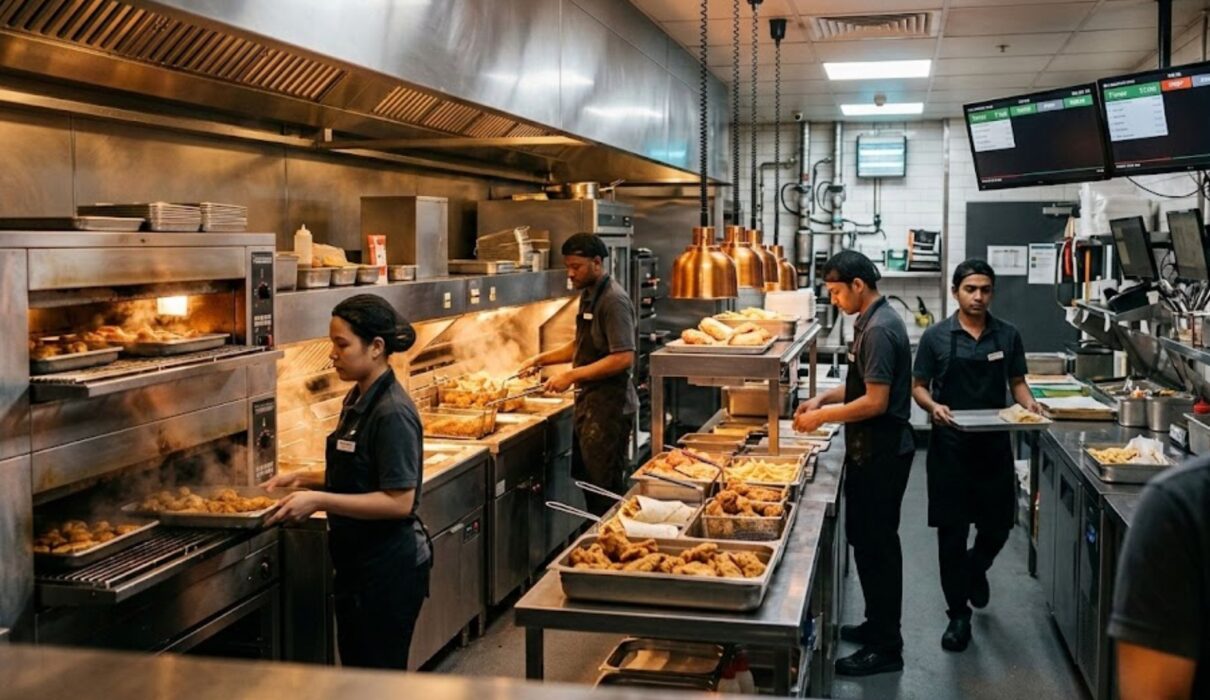
Why High-Volume QSR Equipment Is the Foundation of Profitable Growth 2026
Running a quick service restaurant at high volume is not just about a busy location or a popular menu. It is about whether your commercial kitchen equipment can keep pace with demand during every rush, every shift, every day of the week.
The global QSR equipment market is projected to reach USD 27 billion by 2032, growing at a CAGR of 8.7 percent. The broader QSR sector is on track to hit USD 1.74 trillion at an 8.41 percent growth rate. Asia-Pacific alone is expected to lead with a 37.8 percent market share, driven by rapid urbanization and rising demand for fast, affordable food. For restaurant owners and operators, these numbers mean one thing: the competitive bar for kitchen performance is rising fast.
This guide is written for QSR owners, operations managers, and anyone evaluating commercial kitchen equipment or restaurant equipment suppliers for a high-volume setup. You will find a practical equipment matrix, the KPIs that actually matter, the innovations shaping 2026, and a clear-eyed view of where the market is heading through 2031.
Table of Contents
How to Select Cost-Effective High-Volume QSR Equipment
The biggest mistake operators make when sourcing professional kitchen equipment is prioritizing upfront cost over total cost of ownership. A cheaper fryer that breaks down twice a month costs far more than a durable, IoT-enabled unit with a predictive maintenance system.
When evaluating commercial cooking equipment for high-volume QSR operations, four factors should drive every decision.
- Throughput capacity is the starting point. Equipment must be sized for your peak-hour demand, not your average transaction count. As a general reference point, high-speed conveyor ovens typically handle anywhere from 150 to 500+ units per hour, while high-volume fryers can process between 50 to 100 pounds of product per cycle depending on the model and configuration. A conveyor oven or high-speed fryer that cannot recover temperature quickly between batches will bottleneck your entire service line.
- Durability and serviceability matter more at scale. Industrial kitchen equipment in a QSR environment runs for 12 to 18 hours a day. Commercial-grade units are generally engineered for operational lifespans in the range of 7 to 15 years under proper maintenance conditions, though actual longevity varies considerably by usage intensity and upkeep. Specify commercial-grade components, and confirm that your restaurant equipment supplier has a local service network before you sign a purchase order.
- Energy efficiency directly affects your margin. When sourcing equipment, look for units carrying ENERGY STAR certification or equivalent regional energy performance ratings, as these meet independently verified efficiency benchmarks. Energy-efficient refrigeration models alone can cut operating costs by 10 to 15 percent. Induction and electric hybrid cooking equipment reduce utility overhead while meeting tightening sustainability regulations.
- Integration capability determines whether your equipment fits your digital ecosystem. Commercial kitchen equipment that cannot connect to your POS, kitchen display system, or IoT monitoring platform will become a liability as your operation scales.
Wholesale restaurant equipment purchasing through established commercial kitchen equipment suppliers or commercial kitchen equipment manufacturers gives multi-unit operators volume pricing advantages and standardized specifications across locations.
Disclaimer: The capacity ranges, lifespan figures, and efficiency estimates referenced above are general industry benchmarks intended for informational purposes only. Actual performance, durability, and energy savings vary significantly by manufacturer, model, usage conditions, maintenance practices, and operational environment. We make no claims regarding the specific throughput, longevity, or cost savings of any particular equipment or brand. Always consult directly with your equipment supplier or manufacturer for verified specifications before making purchasing decisions.
QSR Equipment Matrix: What to Buy and Why
This matrix covers the core categories of restaurant kitchen equipment for high-volume quick service operations, with performance benchmarks relevant to 2026 and beyond.
| Category | Essential High-Volume Items | Business Benefit | 2026 Benchmark |
| Cooking | Fryers, grills, conveyor ovens | High throughput; 42% of QSR equipment market share | IoT-enabled models deliver 25% efficiency gain |
| Refrigeration | Reach-in fridges, walk-in coolers | Waste reduction and food safety compliance | Energy-efficient units cut costs 10 to 15% |
| Prep and Holding | Food processors, slicers, warming cabinets | Consistency during peak service | Modular designs support cloud kitchen formats |
| Cleaning | Undercounter dishwashers, automated sanitizers | Hygiene compliance and labor reduction | High-volume automated sanitation standard |
| Tech Integration | POS systems, KDS, contactless kiosks, beverage dispensers | Order speed and upsell opportunities | Contactless ordering boosts average order value by 20% |
Use this matrix as a planning reference when briefing commercial kitchen equipment suppliers or comparing quotes from restaurant equipment manufacturers. Every category should be evaluated against your projected peak volume, not your current average.
Key KPIs for High-Volume QSR Equipment Performance
Tracking the right KPIs transforms your equipment from a cost line into a performance system. These are the metrics that connect directly to profitability in high-volume quick service restaurant operations.
- Speed of service: Target under 3 minutes from order to fulfillment. This is the most visible QSR performance metric and the one most directly constrained by cooking equipment throughput and holding cabinet reliability.
- Food cost percentage: The industry benchmark sits between 28 and 35 percent. Equipment that reduces waste through precise portioning, temperature consistency, and smart holding directly improves this number.
- Labor cost ratio: Target below 30 percent of revenue. Automated commercial cooking equipment and programmable controls reduce dependency on skilled labor and lower training overhead, especially in high-turnover environments.
- Equipment uptime rate: Target above 95 percent. Unplanned downtime during peak service is one of the most expensive events in a QSR operation. Predictive maintenance through IoT-enabled professional kitchen equipment cuts unplanned failures and keeps uptime high.
- Energy cost per cover: Total utility spend divided by covers served. Track this monthly and target a 5 to 10 percent annual improvement as you upgrade to more efficient food service equipment.
- Repeat purchase rate: Often overlooked, this metric is directly influenced by food quality consistency. Reliable holding cabinets that maintain precise temperature during rushes protect taste and texture, which drives customer return behavior.
These six KPIs should sit on every QSR owner’s monthly operations dashboard alongside revenue and labor hours.
Top Equipment Innovations Reducing Labor Costs in QSRs
The 2026 innovation landscape in commercial kitchen equipment is defined by three converging forces: automation, connectivity, and sustainability.
- Smart fryers with real-time IoT monitoring are the single most impactful category for high-volume QSR operators right now. These units monitor oil temperature, filtration cycles, and cook times automatically, reducing the need for manual oversight and cutting downtime by up to 20 percent. For catering equipment suppliers and restaurant equipment manufacturers, IoT integration is no longer a premium feature. It is becoming a baseline specification.
- AI-assisted robotics are entering high-volume QSR kitchens for repetitive tasks like burger assembly, fry dispensing, and drink preparation. Early adopters are reporting labor reductions of 5 to 10 percent, which translates directly to margin improvement at scale. This technology is not a replacement for kitchen staff. It is a tool that allows existing staff to focus on quality control and customer interaction.
- Contactless kiosk systems integrated with kitchen display systems are reshaping the front-to-back kitchen workflow. When a customer places an order at a kiosk, that order routes directly to the relevant cooking and prep stations with zero manual handoff. This reduces errors, speeds fulfillment, and has been shown to increase average order value by approximately 20 percent through structured upsell prompts.
- Hybrid and electric cooking equipment is gaining ground as sustainability regulations tighten across major markets. Restaurant operators who are still running older gas-based commercial cooking equipment will face both regulatory pressure and rising energy costs. Electric combi ovens and induction ranges are the transition path that most catering equipment suppliers are actively promoting to multi-unit chains.
- Modular equipment setups are a practical response to the growth of cloud kitchens and hybrid kitchen models. Modular professional kitchen equipment can be reconfigured as menus evolve or as a location shifts between dine-in and delivery-only formats, protecting capital investment across model changes.
IoT Kitchen Technology and Its Impact on QSR Profitability
IoT-enabled commercial kitchen equipment is no longer a future concept. It is an active profitability lever for operators who deploy it correctly.
Connected sensors in fryers, ovens, and refrigeration units collect performance data in real time and feed it to centralized dashboards. For a multi-unit QSR chain, this means operations managers can monitor equipment health across every location without physically visiting each site. Predictive maintenance alerts flag components showing early signs of failure before that failure disrupts a service period.
The financial case is straightforward. A single unplanned equipment failure during a dinner rush can mean hundreds of lost transactions and significant labor disruption. IoT monitoring that prevents even two or three of those events per location per year typically delivers a return that far exceeds the cost of the monitoring system.
Beyond maintenance, IoT data enables smarter purchasing and energy decisions. Operators can see exactly how much energy each piece of industrial kitchen equipment is consuming per shift, compare that against throughput data, and identify inefficiencies that would otherwise be invisible.
Franchise vs. Independent QSR Growth Projections 2026 to 2031
The growth outlook differs significantly between franchise systems and independent QSR operators, and that difference should shape how each group approaches restaurant equipment investment.
Franchise systems benefit from centralized procurement, standardized restaurant kitchen equipment specifications, and volume pricing through established commercial kitchen equipment suppliers. Franchisees buying into proven systems inherit a tested equipment blueprint, which reduces planning risk and accelerates opening timelines. Predictive analytics built into franchise operations systems are projected to deliver 15 to 20 percent throughput improvement over the next five years.
Independent QSR owners face a different challenge. They are building their equipment strategy without the safety net of a franchisor’s buying power or operational playbook. However, independents who invest in IoT-enabled food service equipment and track the six KPIs outlined above will be positioned to scale efficiently. The key advantage independents hold is flexibility: they can adopt innovations faster than franchise systems with rigid equipment standards.
Both groups are operating in a market where Asia-Pacific is expected to lead global QSR growth through 2031, where automation adoption will accelerate, and where operators who treat their commercial equipment for restaurants as a strategic asset rather than a commodity purchase will consistently outperform those who do not.
Frequently Asked Questions
How to select cost-effective high-volume QSR equipment?
Prioritize total cost of ownership rather than purchase price. Evaluate throughput capacity at peak demand, energy efficiency ratings, durability under continuous use, and integration capability with your POS and kitchen display systems. Work directly with commercial kitchen equipment suppliers who offer service networks in your operating area, and use volume purchasing through wholesale restaurant equipment channels when standardizing across multiple locations.
What are the top equipment innovations for reducing labor costs in QSRs?
IoT-enabled fryers with real-time monitoring, AI-assisted robotics for repetitive prep tasks, and contactless kiosk systems integrated with kitchen display systems are delivering the most measurable labor cost reductions in 2025 and 2026. These tools reduce manual oversight, lower training complexity, and allow existing staff to focus on quality control. Restaurant equipment manufacturers are increasingly building these capabilities into standard commercial kitchen equipment specifications.
What strategies help independent QSR owners scale using KPIs?
Independent operators should build a monthly KPI dashboard tracking speed of service, food cost percentage, labor cost ratio, equipment uptime, energy cost per cover, and repeat purchase rate. These six metrics create visibility into exactly where production constraints and cost inefficiencies exist. Equipment decisions should be made in response to what the KPIs are telling you, not in response to trends or supplier pressure.
What is the impact of IoT kitchen technology on QSR profitability?
IoT-enabled commercial kitchen equipment improves profitability through three mechanisms: predictive maintenance that prevents costly unplanned downtime, real-time energy monitoring that identifies consumption inefficiencies, and centralized performance dashboards that allow multi-unit operators to manage kitchen health across all locations from a single interface. Operators who have deployed IoT monitoring consistently report downtime reductions of 15 to 20 percent, which translates directly into throughput and margin gains.
What are the franchise vs. independent QSR growth projections for 2026 to 2031?
Both models are positioned for growth within a QSR sector projected to reach USD 1.74 trillion. Franchise systems will benefit from standardized equipment procurement, AI-driven predictive analytics, and proven operational blueprints that reduce scaling risk. Independent operators who invest in IoT-enabled food service equipment and data-driven operations can compete effectively, particularly in underserved markets where franchise presence is limited. Asia-Pacific represents the largest growth opportunity for both models through 2031.
How do modular equipment setups support QSR expansion into cloud kitchens?
Modular professional kitchen equipment is designed to be reconfigured as your operational model evolves. For QSR operators entering cloud kitchen or ghost kitchen formats, modular setups reduce fixed infrastructure costs and allow rapid repositioning between delivery-only, hybrid, and dine-in configurations. Catering equipment suppliers and commercial kitchen equipment manufacturers are actively developing modular product lines in response to the growth of nontraditional kitchen formats across Asia-Pacific and other emerging markets.