What Is Kitchen Equipment Planning for Expanding Restaurant Chains and Why Does It Matter?
If you are a restaurant owner preparing to open your second, fifth, or tenth location, revenue projections are likely already in place. But here is what most expansion plans get wrong: the bottleneck is not demand. It is a production system.
Kitchen equipment planning is a structured process that involves selecting, sizing, sequencing, and budgeting commercial kitchen equipment to align with your operational goals. Done right, it allows you to scale without losing food quality, service speed, or profit margins. Done wrong, it produces a cascade of problems, including downtime, compliance failures, inconsistent output, and runaway utility costs.
The global commercial kitchen equipment market is approaching $41 billion in projected value, and the quick service restaurant sector is growing at a compound annual rate of 7.4 to 9 percent through 2029 to 2030. These numbers signal sustained demand, which means operators who build scalable kitchen infrastructure now will be better positioned to capture growth than those who react to problems after they open.
This guide gives restaurant owners, operations directors, and foodservice consultants a clear framework for planning kitchen equipment at every stage of expansion.
Table of Contents
Why Kitchen Equipment Is a Strategic Asset, Not Just a Purchase
Many restaurant operators treat equipment procurement as a one-time transaction. It is not. Commercial kitchen equipment is your production infrastructure, and it directly determines whether your business scales cleanly or struggles under its own growth.
Equipment planning influences throughput capacity during peak hours, labor productivity per shift, energy consumption and utility overhead, brand consistency across locations, and maintenance downtime risk. A mismatched cooking line or an underpowered refrigeration unit at one outlet does not just slow that location. In a chain environment, it creates brand inconsistency that compounds across every unit you operate.
The shift in mindset is simple: equipment is a capital asset that either enables or constrains your business model. The earlier you treat it that way, the better your expansion economics become.
The Market Context: What the Numbers Tell Operators
Understanding market conditions helps sharpen every equipment and investment decision you make.
Ventless cooking equipment has seen approximately 15 percent demand growth in certain markets, driven by the rise of ghost kitchens and nontraditional spaces. Energy-efficient induction cooking systems can reduce utility costs by up to 90 percent compared to legacy open-flame setups, which makes energy planning a financial decision, not just an environmental one. Emerging economies represent a significant untapped opportunity for structured, scalable restaurant models, and operators who enter those markets with modular, rightsized equipment will outperform those who replicate metro-scale kitchens where the demand does not yet exist.
The annual repair cost threshold matters too. Industry practice puts the replacement trigger at 30 to 40 percent of an equipment unit’s replacement value per year. If your repair bills are consistently crossing that line, replacement is not a cost. It is an investment.
How Much Does Kitchen Equipment Cost at Each Stage of Expansion?
Capital planning is one of the most common pain points in restaurant expansion. The answer to “how much should I spend” depends entirely on where you are in your growth journey.
| Expansion Stage | Investment Range (USD) | Equipment Focus | Strategic Objective |
| Initial Growth | $15,000 to $30,000 | Core cooking line, reach-in refrigeration, and ventilation basics | Establish production capacity and compliance |
| Growth Scaling | $30,000 to $60,000 | Walk-in coolers, advanced cooking systems, and POS integration | Increase throughput and operational integration |
| Multi-Unit Expansion | $60,000 and above | Central kitchen systems, automation, IoT monitoring | Standardize operations and reduce multi-location risk |
The discipline here is phasing. Matching capital expenditure to actual revenue growth rather than theoretical ambition protects cash flow and reduces the risk of expensive overcapacity.
The Right Planning Framework: Start With Data, Not Equipment Catalogs
Experienced foodservice engineers do not start with product specifications. They start with operational data. Here is the professional sequence:
- Menu-Driven Volume Assessment
Before selecting any equipment, you need to know your peak-hour transaction count, the average preparation time per menu item, the cooking methods your menu requires, whether you are cooking to order or in batches, and what your menu looks like 12 to 24 months from now. High-capacity ovens and blast chillers should be sized against peak load, not average sales. Oversizing wastes capital. Undersizing collapses service during your busiest hours.
- Workflow and Layout Design
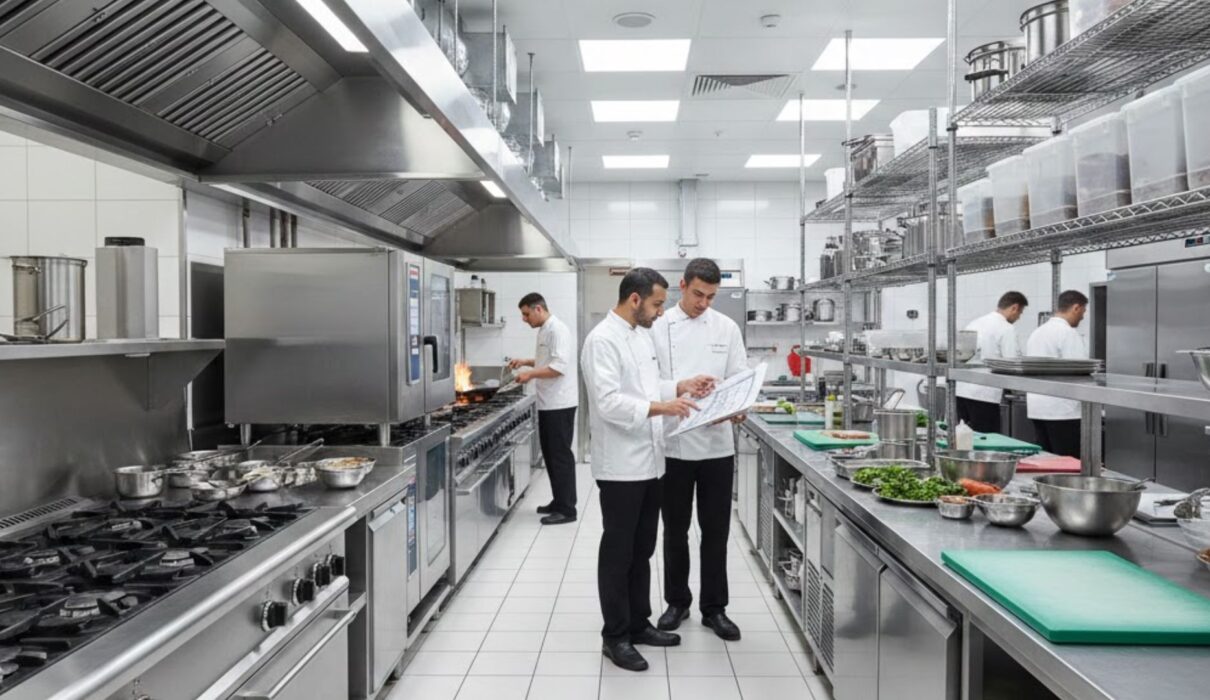
A well-designed kitchen follows a clean-to-dirty workflow: raw storage, preparation, cooking, plating, and warewashing, with no cross-contamination points. Professional standards recommend 4 to 6 feet of preparation space per cook. Tighter layouts increase accident risk and reduce throughput, both of which erode margins. Compliance frameworks like NFPA 96 govern ventilation and fire suppression design, and those engineering decisions must be finalized before you procure a single piece of equipment.
- Phased Equipment Rollout
Install core preparation and cooking equipment first. Specialized tools follow once volume justifies the expense. This approach keeps your capital expenditure in alignment with actual revenue and reduces financial strain during the most vulnerable phase of any expansion.
Core Equipment Categories and What They Contribute
Getting the right mix of equipment is not about buying everything available. It is about understanding what each category contributes to your production model.
Combi ovens deliver controlled steam and convection cooking, making them ideal for batch consistency across locations. Conveyor ovens support standardized high-volume output with minimal operator variability. Induction ranges provide precise temperature control and significantly lower energy costs compared to open-flame cooking. Fryers and charbroilers must be sized to handle peak service without recovery delays, because an undersized fryer during a dinner rush is a brand problem, not just a kitchen problem.
On the refrigeration side, walk-in coolers and freezers should be sized to reflect inventory turnover, not maximum theoretical storage. Oversized cold storage wastes energy. Undersized cold storage creates a food safety risk. Blast chillers are essential in any centralized or hybrid kitchen model where batch production must be safely cooled before distribution. Low global warming potential refrigerants should be specified from day one, as regulatory requirements in this area are tightening across most major markets.
Preparation and holding equipment, including mixers, food processors, portioning tools, and heated pass-throughs, reduces training complexity and labor dependency. This matters particularly in high-turnover restaurant environments where skill consistency across outlets cannot be assumed.
KPIs Every Restaurant Operator Should Track for Kitchen Equipment
Most restaurant operators track revenue and food cost. Far fewer track the equipment-level indicators that predict whether their kitchens will actually scale. Here are the metrics that matter:
- Equipment utilization rate: Percentage of total capacity used during peak service. A healthy range is 70 to 85 percent. Consistently below 60 percent signals oversizing. Consistently above 90 percent signals a bottleneck.
- Annual repair cost as a percentage of replacement value: Below 20 percent is manageable. Above 30 percent is a replacement signal.
- Energy cost per cover: Total utility spend divided by covers served. Target a 5 to 10 percent annual reduction as equipment efficiency improves.
- Order ticket time: Time from order placed to food ready. Below 8 minutes for QSR, below 15 minutes for casual dining. A rising trend week-over-week is a throughput warning.
- Recovery time after peak: The time for fryers or ovens to return to operating temperature after heavy use. Over 5 minutes consistently signals undersized or aging equipment.
- Downtime incidents per month per unit: More than 2 unplanned failures per month per location warrant an immediate maintenance and replacement review.
These KPIs should be reviewed at least monthly across all locations. In a multi-unit chain, centralizing this data through an IoT monitoring dashboard is the most efficient way to catch problems before they become service failures.
Infrastructure Engineering: The Step Most Operators Skip
Equipment only performs well if the infrastructure supporting it is correctly engineered. This is where many expansion projects accumulate costly delays.
Ventilation systems must handle the cumulative heat load of your full cooking line, not individual units in isolation. Undersized ventilation leads to comfort problems, compliance failures, and potential health code violations. Fire suppression systems must integrate with hood assemblies and meet local code requirements, and these specifications must be locked in before equipment layouts are finalized.
Electrical panels require load diversity calculations. An undersized panel causes nuisance tripping and equipment underperformance, and upgrading electrical service after opening is expensive and disruptive. Grease traps, drainage, and plumbing must comply with local municipal codes. Noncompliance can force shutdowns after opening, which is one of the most damaging things that can happen to a brand during a growth phase.
The rule is simple: engineering planning must precede equipment procurement. Every dollar invested in professional engineering upfront prevents multiple dollars in retrofit costs later.
Technology Integration and the Connected Kitchen
The commercial kitchen equipment industry is moving toward connected, data-driven operations, and for chains with five or more locations, this shift is already a competitive requirement.
IoT-connected sensors monitor equipment performance in real time and alert operators before failures occur. Centralized dashboards allow operations teams to manage maintenance scheduling across all locations from a single interface. Kitchen display systems and automated order routing reduce ticket errors and improve service speed. AI-driven automation is gaining traction in high-volume QSR formats, where it stabilizes output for repetitive cooking tasks and partially offsets ongoing labor shortages.
Ventless cooking technology is a growing category worth tracking. It allows restaurants to operate in smaller footprints and nontraditional spaces without full ventilation infrastructure, which directly supports ghost kitchen and hybrid kitchen expansion strategies.
Choosing Your Operational Model
As your chain expands geographically, your operational model determines your entire equipment strategy. Central kitchens consolidate bulk production and leverage industrial-scale equipment, but introduce logistics complexity and reduce menu flexibility at the outlet level. Distributed kitchens give each outlet full production autonomy but require standardized equipment specifications across locations to maintain consistency. Hybrid systems combine centralized preparation with final cooking at each outlet and must address both the central production facility and outlet finishing lines in their equipment planning.
Most chains evolve from distributed toward hybrid or central models as they grow beyond 8 to 10 units. The right model depends on your logistics capability, market density, and how complex your menu is.
Final Thought
Kitchen equipment planning is not a procurement function. It is a strategic one. The decisions you make about equipment capacity, layout engineering, technology integration, and capital phasing will determine whether your expansion delivers the margins you projected or creates operational drag that compounds across every location you open.
Restaurant chains that treat equipment as a long-term strategic asset, invest in engineering planning before procurement, and align capital expenditure with actual revenue growth are the ones that scale successfully and profitably.
Frequently Asked Questions
How do you size kitchen equipment for different city tiers?
Expansion into metro markets versus secondary or tertiary cities requires a full demand recalibration. Footfall projections, delivery volume, and price sensitivity differ significantly between market tiers. Equipment capacity should reflect realistic peak loads in each specific market. Replicating a metro kitchen prototype in a smaller market typically leads to costly overcapacity and inflated utility overhead.
Should expanding restaurant chains lease or purchase kitchen equipment?
Leasing reduces upfront capital burden and preserves liquidity during early expansion stages. Purchasing provides better long-term economics and builds asset ownership. The right choice depends on cash flow strength, tax planning strategy, and how confident you are in the long-term viability of each specific location. For rapid multi-unit expansion, equipment financing or fleet leasing agreements with volume pricing can offer a middle path.
How does staff skill level affect equipment selection?
In multi-unit operations with variable workforce skill levels, equipment with programmable controls and automated cycles reduces output variability across locations. This is especially important in high-turnover or labor-constrained markets where you cannot rely on consistent culinary expertise across every shift. Shorter training time to competency is itself a measurable KPI worth tracking.
What role does sustainability play in long-term kitchen equipment planning?
Sustainability is increasingly linked to regulatory compliance and brand positioning, not just environmental responsibility. Energy-efficient systems, low-emission refrigeration, and water-saving warewashing equipment reduce both environmental impact and operating costs simultaneously. Forward-looking chains incorporate sustainability into equipment decisions from the beginning as a financial strategy, because the regulatory direction in most major markets is clear.