How Major Restaurant Chains Standardize Commercial Kitchen Appliances
Scaling a restaurant chain is not only about marketing, branding, or rapid expansion. It is about building a repeatable operational system that delivers the same food quality, service speed, and kitchen efficiency in every location. Customers expect identical taste and experience whether they visit the first outlet or the hundredth. Consistency builds trust, and trust drives loyalty.
This consistency depends heavily on how brands standardize their commercial kitchen equipment. From selecting reliable restaurant equipment suppliers to forming long-term partnerships with commercial kitchen equipment manufacturers, major brands treat equipment as a strategic asset rather than a simple purchase.
Below is a structured and practical breakdown of how leading chains standardize their restaurant chain kitchen equipment to support growth, profitability, and long-term operational stability.
Table of Contents
The Strategic Role of Standardization in a Restaurant Chain
Standardization is the operational backbone of any successful restaurant chain. Without it, expansion leads to inconsistencies, higher operating costs, and workflow confusion.
When identical restaurant equipment is installed across locations, cooking performance remains stable. Grills heat evenly. Fryers recover temperature at the same rate. Ovens deliver consistent results. This stability ensures that food tastes the same in every outlet.
Uniform industrial kitchen equipment also simplifies training. Staff members can move between outlets without learning new systems. This flexibility is critical in a fast-growing food chain where workforce mobility is common.
Bulk purchasing agreements with approved restaurant equipment suppliers strengthen procurement power. Large-scale sourcing reduces per-unit costs and simplifies warranty management. Close collaboration with trusted commercial kitchen equipment manufacturers ensures long-term supply consistency and spare parts availability.
For operators, this means predictable performance. For customers, it means consistent quality.
Menu Engineering as the Foundation of Equipment Planning
Before selecting commercial kitchen equipment, successful chains finalize their menu strategy. Equipment always follows operational need, not trends.
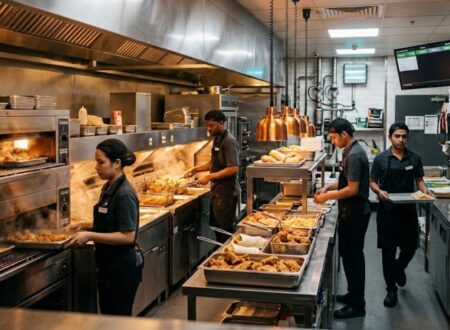
Each food chain kitchen setup reflects its core offerings. A grilled concept prioritizes high-capacity grills. A fried-food brand invests in efficient fryers. A bakery-focused restaurant chain depends on precision ovens and proofing systems.
High-volume outlets require durable industrial kitchen equipment that can operate continuously. At the same time, urban locations demand compact yet high-output systems to maximize limited space.
Leading brands test equipment before full rollout. Performance, durability, and energy efficiency are evaluated carefully. Once approved, the model becomes part of the official restaurant chain kitchen equipment blueprint. This structured validation prevents costly expansion mistakes.
Designing a Replicable Food Chain Kitchen Setup
A well-planned food chain kitchen setup acts as a blueprint for growth. Replication reduces errors and speeds up new outlet launches.
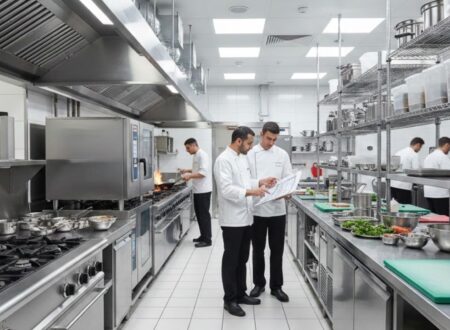
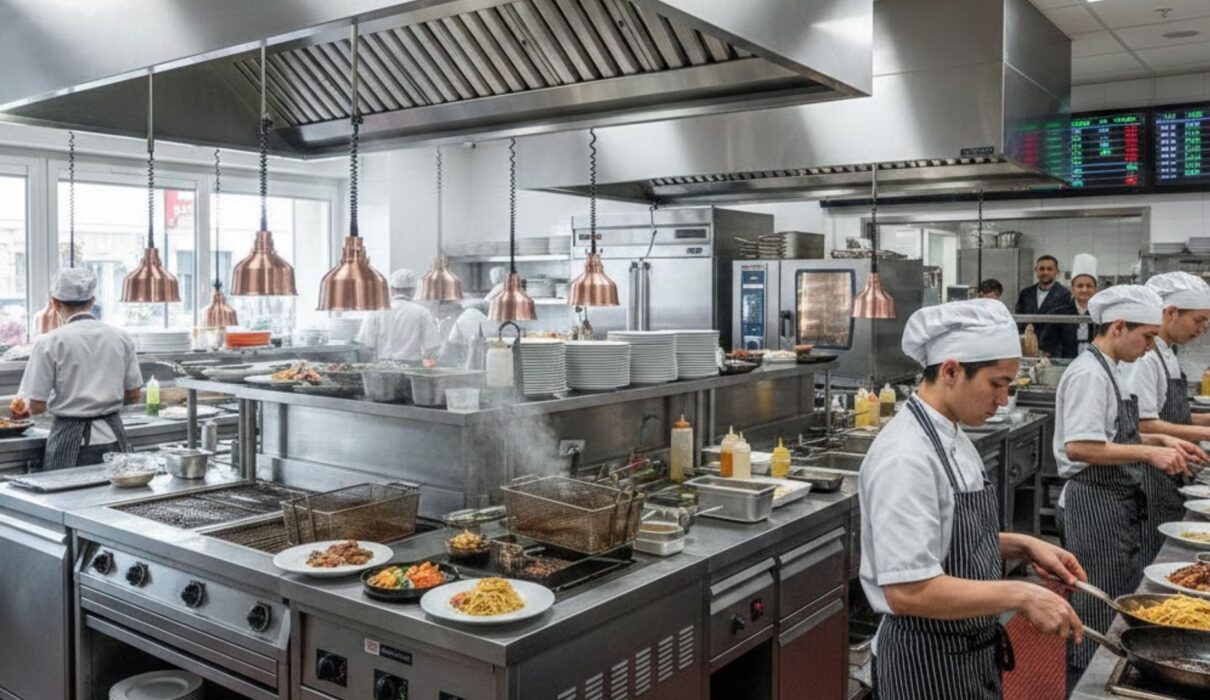
Major chains document equipment placement, utility requirements, ventilation systems, and workflow paths. This ensures that every location installs identical standardized kitchen equipment for franchises.
- Creating a Standard Kitchen Blueprint: Clear documentation defines equipment positioning, prep zones, storage layout, and safety pathways. The layout minimizes unnecessary staff movement and supports efficient service flow.
- Maintaining Workflow Consistency Across Outlets: When physical environments remain consistent, productivity increases. Staff know exactly where tools and machines are placed. This reduces confusion and speeds up operations.
Standardized restaurant chain kitchen equipment creates predictable workflow patterns that improve overall efficiency.
Equipment Categories Commonly Standardized by Major Chains
Most multi-unit brands standardize core categories of hospitality equipment to maintain operational reliability.
| Equipment Category | Purpose in Commercial Kitchen | Operational Advantage |
| Cooking Equipment (Grills, Ovens, Fryers) | Core food production | Ensures taste consistency |
| Refrigeration Units | Ingredient storage | Maintains food safety |
| Preparation Tables | Assembly and portioning | Improves workflow speed |
| Dishwashing Systems | Cleaning and sanitation | Supports hygiene compliance |
| Ventilation Systems | Heat and smoke control | Enhances safety and comfort |
By standardizing these components of commercial kitchen equipment for restaurant chains, brands reduce variability and strengthen operational control.
Supplier Partnerships and Long-Term Equipment Management
Strong supplier relationships are central to effective standardization.
Global brands collaborate with commercial kitchen equipment manufacturers to customize specifications that match operational needs. This ensures durability, compatibility, and energy efficiency.
Approved restaurant equipment suppliers coordinate installation, training support, and after-sales service. This reduces delays when launching new outlets.
When identical industrial kitchen equipment models are used across locations, maintenance becomes predictable. Spare parts inventory is centralized. Technicians develop expertise in specific systems. This structured approach reduces downtime and protects revenue in high-volume food chain operations.
Integrating Technology into Commercial Kitchen Equipment
Technology integration has become a defining factor in modern commercial kitchen equipment strategy for every growing restaurant chain. Smart systems enhance operational visibility, strengthen food safety compliance, and reduce manual dependency across each food chain kitchen setup. When these technologies are standardized across locations, performance becomes measurable and scalable.
Key Technological Integrations
- IoT & Remote Monitoring: Connected ovens, refrigeration units, and holding cabinets enable real-time temperature tracking, remote control access, and automated alerts to prevent equipment failures.
- Automation & Robotics: Programmable cooking systems and robotic assistance handle repetitive tasks with precision, ensuring uniform output and minimizing human error.
- Advanced Cooking Technologies: Induction systems and precision heat solutions improve energy efficiency, enhance safety, and deliver consistent cooking performance.
- Smart Inventory & Food Safety Controls: RFID tracking and digital sensors monitor stock levels and compliance standards, reducing waste and minimizing food safety risks.
By integrating these innovations into standardized commercial kitchen equipment for restaurant chains, operators improve productivity, reduce labor pressure, and create a future-ready operational framework.
Compliance, Safety, and Regulatory Alignment Across Locations
Expansion into new regions exposes a restaurant chain to varying health codes and safety regulations. Without structured systems, compliance becomes complex.
Standardizing commercial kitchen equipment simplifies this challenge. Uniform refrigeration, cooking temperatures, and sanitation systems ensure consistent food safety standards.
- Meeting Health and Food Safety Standards: Pre-approved restaurant equipment simplifies inspections and internal audits. Compliance becomes easier to manage across multiple outlets.
- Fire Safety and Ventilation Consistency: Standardized ventilation and fire suppression systems, key components of hospitality equipment, improve staff safety and reduce liability risks.
- Adapting to Local Regulations Without Losing Standardization: Minor adjustments to specifications allow flexibility while preserving the core food chain kitchen setup.
This balance supports safe and confident expansion.
Energy Efficiency and Sustainability in Industrial Kitchen Equipment
Energy costs multiply as a restaurant chain grows. Standardizing energy-efficient industrial kitchen equipment helps control long-term utility expenses.
When identical commercial kitchen equipment operates across locations, energy benchmarks become meaningful. Lower electricity and water consumption improve profitability.
Customers increasingly prefer environmentally responsible brands. Investing in efficient restaurant chain kitchen equipment demonstrates a commitment to sustainability.
Smart refrigeration systems, optimized ventilation, and automated cooking controls reduce waste while maintaining consistent output. For modern food chain operators, sustainability supports both financial performance and brand reputation.
Managing Equipment Lifecycle and Replacement Strategy
Standardization simplifies long-term asset management.
When identical commercial kitchen equipment for restaurant chains is installed everywhere, maintenance schedules become predictable. Service teams understand specific models, reducing diagnostic time.
Using uniform restaurant equipment streamlines spare parts management. Centralized inventory lowers storage costs and speeds up repairs across the network.
Structured lifecycle planning prevents sudden disruptions. By working closely with reliable restaurant equipment suppliers, chains schedule phased upgrades instead of reacting to emergencies.
This proactive approach protects revenue and supports steady growth.
Technology, Automation, and the Future of Commercial Kitchen Equipment
Technology continues to reshape professional kitchens.
Modern commercial kitchen equipment integrates remote monitoring and digital performance tracking. When standardized across a restaurant chain, data becomes consistent and reliable.
Automation improves speed and accuracy. Programmable ovens, timed fryers, and digitally controlled refrigeration strengthen consistency within every food chain kitchen setup.
Future-ready industrial kitchen equipment will likely integrate AI-driven cooking optimization and predictive maintenance. Brands that already operate with standardized restaurant chain kitchen equipment will adopt these innovations more smoothly and cost-effectively.
Conclusion:
Standardization is not just an operational decision. It is a strategic growth framework for any expanding restaurant chain.
By aligning menu strategy with the right commercial kitchen equipment, building strong partnerships with commercial kitchen equipment manufacturers, and sourcing through trusted restaurant equipment suppliers, brands create a stable foundation for expansion.
A structured food chain kitchen setup ensures consistent quality, efficient training, predictable maintenance, and controlled costs. Standardized industrial kitchen equipment reduces risk, improves compliance, and supports scalability.
In a competitive hospitality industry, consistency defines credibility. For any ambitious food chain, investing in standardized restaurant chain kitchen equipment is not optional. It is the system that transforms growth into long-term success.
Frequently Asked Questions:
Why do major restaurant chains standardize commercial kitchen appliances?
Major restaurant chain brands standardize appliances to ensure consistent food quality, faster training, predictable maintenance, bulk purchasing benefits, and smooth expansion across multiple locations and regions.
How does standardized kitchen equipment improve operational efficiency?
Standardized commercial kitchen equipment for restaurant chains reduces cooking errors, simplifies workflows, shortens prep time, and ensures every outlet follows the same operational and performance benchmarks.
What role do restaurant equipment suppliers play in standardization?
Reliable restaurant equipment suppliers help chains source uniform appliances, manage bulk orders, provide technical support, and maintain consistency across national or global outlets.
Do standardized appliances reduce maintenance costs for food chains?
Yes. Using identical industrial kitchen equipment across outlets simplifies spare part management, technician training, preventive servicing, and reduces long-term repair and replacement expenses.
How does standardization support franchise scalability?
With pre-approved standardized kitchen equipment for franchises, new outlets follow a proven setup model, reducing setup time, minimizing risks, and maintaining brand-level consistency from day one.
How do commercial kitchen equipment manufacturers support large restaurant chains?
Leading commercial kitchen equipment manufacturers design customized, scalable, and energy-efficient solutions that align with the operational needs of each food chain kitchen setup while ensuring uniform performance standards.
What factors do restaurant chains consider when selecting commercial kitchen equipment?
A growing restaurant chain evaluates durability, energy efficiency, space optimization, compliance standards, after-sales service, and compatibility with existing hospitality equipment before finalizing appliances.